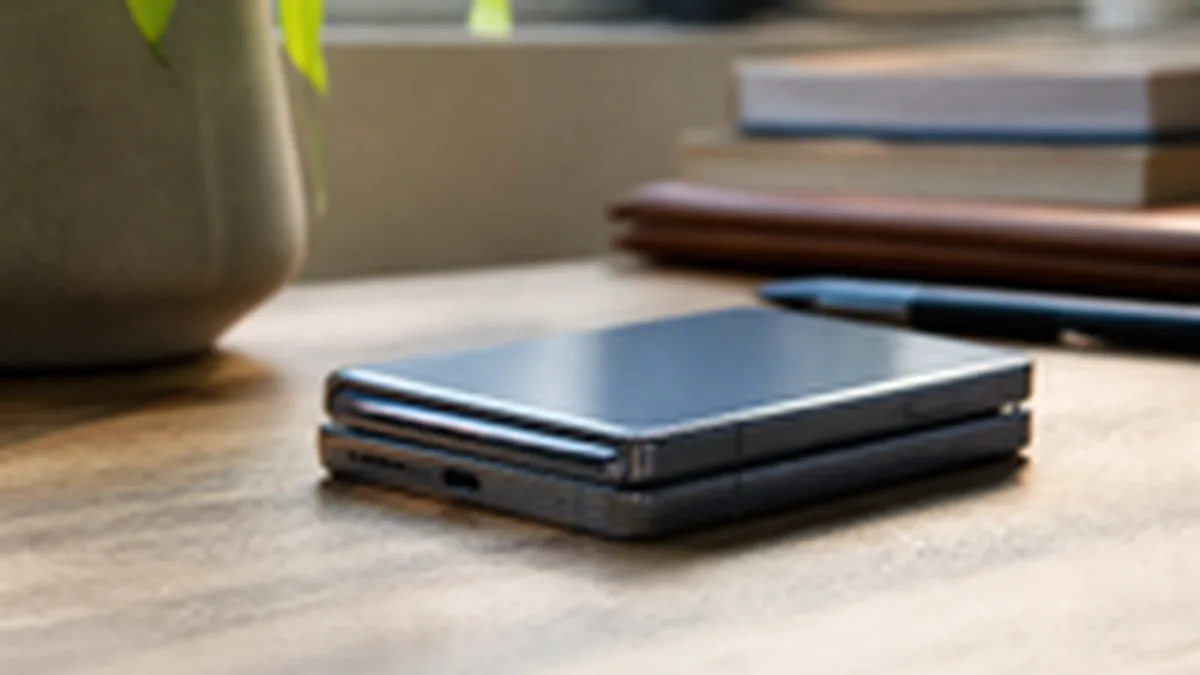
Apple's first foldable phone, the iPhone Duo, started shipping to customers on October 23, 2026, and within days a second wave of search interest appeared alongside the launch buzz: people asking what happens if the inner screen cracks, and what Apple will actually pay for.
That's a fair question. A foldable display is mechanically different from the slab of glass on every iPhone before it, and outlet reporting on repair pricing in the days after launch shows a real gap between what the phone costs to buy and what it costs to fix.
What actually breaks on a foldable
The part of the iPhone Duo most likely to fail isn't the outer cover glass, which Apple has reinforced for years. It's the inner flexible display and the hinge mechanism that lets it fold flat. Reporting from multiple outlets in the week after launch pointed to screen-crack search queries and "internal display break" complaints showing up within hours of early units reaching customers, though neither this article nor the underlying trend data can confirm whether that reflects a systemic defect or a small number of isolated incidents. Treat early post-launch complaint spikes as a signal to watch, not as proof of a pattern, until Apple or independent reviewers publish failure-rate data.
What it costs to fix without AppleCare+
Repair-cost reporting published in mid-October 2026, ahead of the device's ship date, put an out-of-warranty inner-screen replacement at roughly $999 according to some outlets and as high as $1,499 according to others. The spread likely reflects different repair scenarios Apple's own support pricing distinguishes between, such as inner-display-only damage versus damage that also affects the hinge assembly, cover glass, or back housing. Before you pay for any repair, get Apple's current price quote tied to your phone's specific serial number and the exact damage type. Apple's own support and AppleCare+ pages are the only reliable source for your actual repair cost, since third-party estimates reported before and around launch can shift as Apple finalizes its service pricing.
What AppleCare+ actually covers
Apple's standard limited warranty covers manufacturing defects, not accidental damage. That distinction matters enormously for a foldable: a hinge that fails because of a manufacturing flaw is covered for free; a hinge that fails because you dropped the phone, or because grit got into the fold, is accidental damage and is not covered unless you've added AppleCare+.
AppleCare+ extends coverage to accidental damage, typically for a per-incident service fee that is far lower than the full out-of-warranty repair cost, plus a limited number of incidents per coverage period. For a phone where an uncovered inner-screen repair can run into four figures, the arithmetic favors AppleCare+ far more clearly than it did for a traditional glass-slab iPhone, where out-of-warranty screen repairs have historically cost a few hundred dollars.
A simple decision framework
If you bought the iPhone Duo without AppleCare+ and haven't passed Apple's return or coverage-add window, check your eligibility to add it now. If you're still deciding whether to buy the phone at all, treat the AppleCare+ premium as effectively part of the purchase price, not an optional accessory, given the gap between a four-figure uncovered repair and a much smaller per-incident fee under coverage.
If your device develops a problem and you're not sure whether it counts as a defect or accidental damage, start with Apple Support's diagnostic flow or a Genius Bar appointment rather than assuming either way. Apple, not a repair-cost estimate from launch week, makes that determination for your specific unit.
What we don't know yet
As of this article's publish date, Apple has not disclosed a public, verified foldable-display failure rate, and no independent lab has published long-term durability data for the iPhone Duo's specific hinge design. Treat any claim that the phone is unusually fragile, or unusually durable, as unverified until that data exists. This page will be revisited as real-world ownership data accumulates over the device's first 30, 90, and 180 days on the market.
Everyday habits that reduce your actual risk
Regardless of what Apple's eventual failure-rate data shows, a few habits meaningfully lower the odds of needing any repair at all. Avoid letting grit, sand, or fine debris settle into the hinge seam, since foldable displays are more sensitive to particulate intrusion at the fold than a flat glass screen. Use a case specifically designed for the Duo's folding form factor rather than a generic case, since a poor-fitting case can put uneven pressure on the hinge when closed. And be deliberate about opening and closing the phone itself; the repetitive mechanical stress of the fold, not drops alone, is what engineers generally flag as the long-term wear point on any foldable design, Apple's included.
How this compares to normal iPhone repair costs
For context, a cracked screen on a standard, non-folding iPhone has historically cost a few hundred dollars to repair out of warranty, a fraction of the Duo's reported $999 to $1,499 range for inner-display damage. That gap isn't a flaw unique to Apple's execution; it reflects the added manufacturing complexity of any foldable inner display across the industry, Samsung's included. Budgeting for that gap, whether through AppleCare+ or a dedicated savings buffer, is simply part of owning a first-generation foldable device honestly.